Tag Archives: self-help

Overcoming Blind Spots in Our Behavior

We all have blind spots for our behaviour; sometimes it takes someone else to challenge us on our difficult or challenging behaviours. When confronted with these blind spots, we often become defensive or deny them, confusing our behaviour with our sense of identity. We may be within our rights to confront someone about their behaviour, but how we respond makes a difference in whether the situation is diffused or escalates.

If we can respond calmly, we might even get an apology. But if we react with anger, the other person is likely to deny their behaviour. To resolve our anger, we need to identify its source and address it directly with the person involved so they understand the effect their behaviour is having on us. If we stay silent, our bottled-up frustration will probably come out as misplaced anger later.

Accountability is paramount when facing the more challenging parts of our behaviour, feelings and beliefs. While we tend to evaluate others based on their behaviour, we primarily perceive ourselves through the lens of our good intentions rather than the quality of our behaviour. This form of myopia can obscure our awareness, causing us to act out in ways that misrepresent us, and offend others. This is our shadow self or blind-side, the obscured place where opinions, beliefs and prejudices go unnoticed and unchallenged. Developing awareness of our prejudices and assumptions, when processing new information, takes mindfulness and determination. If our behaviour is causing someone distress, it’s important to identify what that behaviour is and adjust our responses accordingly. We need to take responsibility for such maladaptive behaviours by interrupting the automatic cycle that connects emotional triggers to our behaviour and actions. We achieve this through mindfulness. Regular mindfulness practice and a commitment to discovering our true potential can transform our thinking, as well as our words and actions.

When our feelings are clear and unclouded, it leads to more focused thinking. Inspired thoughts that arise from our inner directive lead to inspired action. By taking ownership of our thoughts and actions, we convey a powerful message that we are progressing toward responsibility and unlocking our true potential.

Extract from A Compass for Change – available now on Amazon.

Change and Direction.

One thing to remember when navigating change that it is not a search for something. The seeds of change are already within us, our journey is a measure of distance between germination and fruition. We are born innocent but the seeds of wisdom are within us. Perhaps, we may lose our innocence on the path to wisdom, but the route from one to the other is the journey of a lifetime.  We are precariously perched on wings of hope and destiny, desperately trying not to fall into oblivion. But stronger wings grow from self-love and inner-strength, wings that lift us above fear and failure. These are the wings of Gratitude and Trust.

Our world cannot change by intentions alone. The behaviour and actions we take on our journey of change is reflected in each step along the way. Some parts may be pleasurable, others we take a much needed rest. There may be roadblocks and obstacles along our path, emotions like thunderstorms will rain down upon us to clear the way. Life will deliver the perfect conditions to support and nurture our growth. Pay close attention to conversations, reactions and habits, they hold clues to our unconscious patterns. Be especially vigilant when triggers are pushed, and the cause of it. It is easier to see faults and failings in others than in ourselves; there is an adage in terms of healing that ‘if you spot it you got it.’ We can turn this reflection to our advantage by making a note of what we resist. Our emotions charge our thoughts, our thoughts inform our behaviour, and behaviour creates character. We need to look at our character from an objective place, as an amalgamation of thoughts, emotions and behaviours. All these elements are interchangeable and fluid, it is our refusal to shift perspective that makes the character feel compacted and frozen in time. Real change is never outside of us, it is within. This requires our emotions to flow freely, our behaviour to be malleable and our thoughts to rise like vapour above the limitations of majority thinking.

The infinite in us is aware of the finite span of human life. Change and impermanence walk side by side on the road of mortality. Yesterday is consigned to memory and today is the genesis for tomorrow’s attainment. The illusion that things stay the same is down to the same images playing over and over in our mind. Change is certain and impermanence a given. Life by its very nature plants a seed, roots, germinates, grows, blossoms and bears fruit. The fruit contains the seed of new life and the cycle of life continues again.

Collette O’Mahony 09/03/2024

Extract from my upcoming book – A Compass or Change – available May/June.

Responsibility and Freedom

When we accept responsibility for our thoughts and actions, we set off a chain reaction. We are declaring to the universal mind that we are willing to accept our faults and rejoice in our triumphs. If something goes awry we look to ourselves for the problem rather than blaming others, therefore we give out the message that if we own the problem, we also own the solution. If we hold someone else responsible for a problem, we then depend on them for a solution. The former is energy giving, the latter energy draining. By taking responsibility for a problem we are open to finding solutions that will bring peace of mind, by blaming others we are igniting worry and doubt because energetically we are saying that we have no control over the situation. The road to responsibility may be a long one for those who never learned it as a child or young adult. This is not responsibility for younger siblings, chores or homework; it is self-responsibility, knowing right from wrong and owning our faults as well as accepting compliments in equal measure. Extreme behaviour comes from a lack of measured response to a situation, it is viewing a thing from emotional reaction rather than rational thought. Learning to channel our emotions in an appropriate way avoids their escape in a heightened situation which may lead to quarrel and dispute. This can lead to a disproportionate response to something that is triggered by suppressed emotions.

By using our inner-directive, we have a compass to guide us through change. When the mind slows down, the heart opens and everything becomes clear. Disturbance in our minds and turbulence in our heart obscures our inner-directive and we cannot tell in what direction we must proceed. Our true self is the unhindered, unblemished potential that came into the world. True self is deeper than flesh, it is a wholesome nourishment in the seed of the individual, propagated by truth and nature. A soul on fire, brave and true, breaks through the tough shell of mental inertia to become the exact fruit of its original design. We do not go in search of our true self, it is already with us, healing work is tending to the seed, encouraging it to germinate and cast off the husk of conditioning and unconscious beliefs. Taking responsibility is an important step towards realising our true potential. We must hold ourselves accountable for our thoughts, words and actions, which negatively impact on others, and on ourselves. Every damning word of our inner-critic, toward ourselves or others, shrinks the fulfilment of potential. The seed of potential must be nourished by daily mindfulness to expand awareness.

Collette O’Mahony 16/02/2023

extract from A Compass for Change

Navigating Change

An extract from my upcoming guidebook – A Compass for Change.

When something cataclysmic occurs it has a direct effect on our mental health. This may be a gradual cause like separation and divorce, or an unexpected cause such as sudden death. The cause is the event, the effect is the feelings of loss and grief. We cannot undo the event no matter how much we may wish to but we can gradually process our feelings by giving them our attention. The effect of a job loss may shake our confidence and lead to financial uncertainty, on the other hand it may lead to better opportunities and increased salary. Preparation is the key to success in most fields of endeavour, it is similar for good mental health. Most people face a crisis when unwanted change is forced upon them through tragic or unavoidable circumstance. Similarly, those who try to avoid change reach a point where their health suffers due to a clash between their conditioned mind and their inner directive. The conditioned mind functions on schemas, the parameters laid down by learned habits, beliefs and structure. It arises from childhood and is influenced by family structure, schooling, regional and national thinking. On the other hand, the inner directive is our intuition, that which says something is wrong even if others try to convince you otherwise. Too often we allow ourselves to be swayed by what people think of us, or the mood of the collective.

Our initial response to enforced change is often resistance. This is understandable given how the subconscious operates. It takes longer for our subconscious mind to accept change, it runs on a conditioned loop compromising of our daily habits and cognitive learning, culminating in repetitive behaviour patterns. When these behaviour patterns are thrown into tumult through an unexpected event, the subconscious mind tries to default to the habitual patterns causing the thinking mind to struggle with the new situation. This is something that those who are bereaved struggle with, particularly in the early stages of grief, the conscious mind has to constantly remind the subconscious that their loved one is no longer with them. It can take several months for the subconscious to acknowledge the death, when it eventually does it reduces mental pressure. This permits normal functioning of the mind to resume and allow time for the bereaved person to process grief. Many bereaved people report feeling lost, confused, forgetful or think they are losing their mind; it could just be that the thinking mind is overloaded with functions that are normally designated to the subconscious. The subconscious will eventually register the change and adapt accordingly, but during the adjustment period there are feeling of loss and grief that require inner attention.

Many people take the view that free will is an illusion, and that our behaviour is governed by forces over which we have no control. Consequently, how we act or react is viewed as predictable or unavoidable. Our behaviour can be predictable, but that doesn’t make it’s inevitable. We can choose how to behave, but this is restricted if we determine we have to behave according to our structural belief system. As individuals we are free to choose our behaviour, we have a choice to act responsibly or irresponsibly.

Collette O’Mahony. 10/02/2024

Excerpt from the guidebook – A Compass for Change.

Avoidance Strategies

When love arises, it clears anything unlike itself. All fears, worries, false beliefs rise from the subconscious. Feelings of turmoil surface when fearful emotions and self-sabotaging thoughts start to arise in your awareness. Emotional pain can be acute causing you to use behavioural strategies to avoid difficult thoughts and emotions.

Set your intention to become aware of the avoidance strategies you employ to suppress feelings. It may be unhealthy habits such as overeating or food obsession, overspending on clothes, accessories or household items. Dependence on harmful substances such as drugs and alcohol are often used to mask emotional pain. Control issues such as obsessive-compulsive disorder or escapism into fantasy are attempts to numb the feeling body. Whatever your avoidance strategy, it affects your behaviour and those around you. Perhaps you are not aware you are using avoidance strategies. In many cases addiction is used to avoid your inner truth. Addiction is not the root of the problem, it is a symptom. The stronger the addiction is, the greater the pain beneath it. Guilt and shame compound addictions. Identifying with your habit or addiction strengthens its hold over you to the point where you are not even aware of it. Ask a trusted friend to help you identify your avoidance habits. Deeper issues such as substance abuse require the guidance of a professional. Once you see your avoidance strategy, set your intention to break the habit. Know that it is a learned behaviour pattern, it is not who you truly are. It is a temporary mask to cover the real you.

As fears come into your awareness, it takes vast amounts of energy to avoid them. Through ego, you use all kinds of distraction to avoid seeing truth. You want to avoid painful feelings arising from your past. Each time you identify with shame or guilt, you lock up the feelings energising them. Memories charged by fear, anger, or guilt have been shut in the emotional closet for too long. With positive intention and commitment to creating a new reality, avoidance habits rise into your awareness. When a feeling reaches the universal field of awareness, it can no longer operate in you through unconscious habits. You receive an inner nudge when you are reaching for another slice of cake or pouring one more glass of wine. At this point you can no longer blame your habit; you have an opportunity to make a choice to align with your intention for healing. You can ignore your behaviour or use the prompt to sit with arising feelings. Choose the present moment to overcome fear, expand your vision and create a new reality.

When you commit to being present, feelings associated with the past can be felt and released. Each time you acknowledge your avoidance mode, its grip weakens. Whether you feel attachment or guilt to the behaviour pattern, remain present to the feeling. Distracting yourself from the feeling only serves to strengthen it. To dissolve difficult feelings of guilt, shame, jealousy or anger, allow it to be present in this moment. Through your presence, these feelings can be absorbed by the universal field of awareness and transformed into free-flowing energy.

Collette O’Mahony

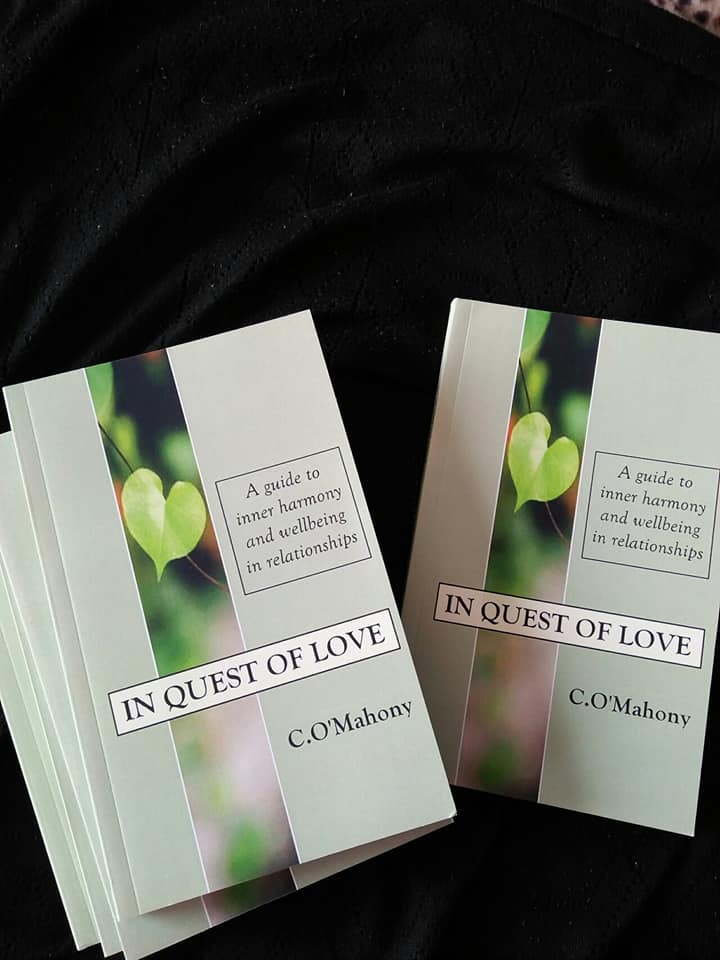
An extract from my book In Quest of Love

Click on image for availability.

In Quest of Love by Collette O’Mahony