Beneath the surface tensions cracking like chasms across our world, there is an inner world, a centre point where we replenish our energy. Now more than ever, it is important to draw our focus inward. Our energy is our most precious resource. When we lose sight of this, our attention shifts to outer, more tangible sources such as gas, oil and money. Attention itself functions as an energy source for leaders, industries and technologies that depend on visibility and engagement. This is one reason we perceive them as powerful; our sustained attention amplifies their influence. In this way, our precious resource, energy, is consumed and scattered across continents in the pursuit of profit and supremacy.
Internal conflict, when left unexamined, reflects outward as division in the world.
High-conflict traits are becoming more audible in the world. This noise drowns out the inner quiet we need in order to replenish our energy. A shift is required: away from pathologising outer conflicts, whether at home, at work or politically, and towards reclaiming our own agency and tending to our inner landscape.
If we find ourselves over-identifying with social and political rifts, it is worth examining what we gain from this attachment. There is a double-edged sword in engaging with people or groups caught in high-conflict patterns: validation on one side, criticism on the other. The outer dynamic may mirror an unconscious pattern in which we seek validation while capitulating to overly critical or controlling behaviour. We must decide where our responsibility for other people’s behaviour ends, and where our responsibility for safety and inner peace begins.
Inner and Outer Boundaries
Every country has its own boundaries, whether drawn on land or by sea, and people operate within its laws. When boundaries are invaded, conflict arises; the twentieth century stands as testament to this. We, too, have boundaries. We protect them by remaining centred and by drawing our focus inward. When we allow our attention to drift towards conflict and drama, we become vulnerable to invading forces. Once our energy strays beyond our boundaries, it is picked up and scattered like salt across the wound of the world.
Perhaps the work, then, is not to resolve the conflicts of the world, but to notice where our attention rests and to choose, again and again, where we place our energy. In moments of tension or outrage, we might pause and return to the quiet centre within, where boundaries are felt rather than defended. From this place, harmony becomes less about agreement and more about presence; less about changing others, and more about remaining intact ourselves.
Collette O’Mahony
21st January 2026
For enquiries about one-to-one counselling (zoom) click below: colletteomahony.com/counselling Psychotherapy
or,
send an email with you name and counselling goals to:
A key to achieving emotional balance is in understanding the sources of our energy. Is it renewable energy, grounded in mindfulness, self-awareness, and intrinsic motivation? Or are we relying on a secondary energy source, which is often external and unsustainable, such as seeking validation, praise, or status?
Renewable energy is internal, arising from practices that foster emotional and mental well-being. This kind of energy comes from a place of mindfulness, self-awareness, and an authentic connection to oneself. When we draw from this energy, we are more likely to experience emotional resilience because we are not dependent on outside circumstances or external validation. We are grounded in our inner self-worth, capable of staying calm in the face of adversity, and able to make thoughtful decisions rather than reacting impulsively to fear or stress. Renewable energy is self-sustaining. Mindfulness practices, such as meditation, journaling, or spending time in nature, help cultivate this energy. It is also nurtured by an ongoing practice of self-compassion, where we approach challenges with curiosity and patience rather than self-judgment.
This energy allows us to face both optimism and pessimism without getting lost in extremes, because it fosters emotional flexibility—the ability to respond appropriately to whatever arises.
Secondary energy sources are externally driven, often coming from a need for praise, validation, status, or attention. These sources of energy are less stable and can be fleeting, which makes them unreliable when facing emotional challenges. If our emotional well-being is tied to how others perceive us, we become vulnerable to external fluctuations. For example, if we rely on praise to feel good about ourselves, it can lead to a pattern of people pleasing and co-dependency. On the other hand, when we don’t receive the validation we seek, it can trigger pessimism and feelings of worthlessness. Relying on external energy sources creates a cycle where our emotional state is dictated by circumstances beyond our control. This can leave us feeling emotionally depleted, causing us to oscillate between extremes of behaviour, from excessive optimism when things go well to deep pessimism when they don’t.
Just as we learn unhelpful habits, such as relying on external sources of energy, we can also unlearn them. Firstly, we need to recognise patterns of behaviour. Behavioural Therapies such as CBT helps us chart our maladaptive behaviour patterns and to recognise triggers that lead to these spirals.
For online one-to-one therapy sessions please get in touch with me at: info@colletteomahony.com.
Excuses can be seen as a way to mitigate personal responsibility or as a subtle form of apology. We often use them in hopes of softening the frustration of someone we have let down, yet consistently relying on excuses can reveal a conscious or unconscious attempt to manipulate other people’s emotions, seeking either pity or control. It’s important to differentiate between someone making an excuse to spare another’s feelings and someone doing so to avoid accountability.
We employ all kinds of excuses to justify poor behaviour. These excuses spring from our belief system and are fertilised by unconscious guilt, shame or denial. Admitting we are wrong deflates the ego, while using an excuse neutralises the effect on our self-esteem. Using excuses like being distracted or overwhelmed with work is less damaging to our ego than admitting we are negligent or forgetful. Excusing our behaviour shifts responsibility to external factors, allowing us to avoid accountability. In so doing, we do not have to feel or process any guilt associated with our behaviour.
When we continually use excuses to mask our behaviour, we are signalling to the world that we have no control over our actions. Our energy conveys that we are not mature enough to take responsibility for our choices and their consequences. Excuses and denial are weeds that choke the seeds of potential. Every excuse we make to avoid facing our emotions stunts our growth, and the harm we inflict on our authentic self is mirrored back to us by the outer world.
Energy Signals
Feelings, such as shame and guilt, are less desirable than dignity or pride, and call for humility. It is the value judgment we attach to an emotion that characterises the feeling as right or wrong, good or bad. These labels are often subjective and are shaped by past experiences and beliefs. The key to releasing an emotion is to allow it to exist without assigning a value to it. This form of acceptance is transformational.
Emotions are energy signals from our body informing us of certain behaviours that are out of alignment with our authentic self. If we’ve wronged someone, they serve as a prompt to address the situation. If we avoid the prompt, the energy from the emotion is projected in the mind and becomes distorted by value judgements. For instance, a man cuts ahead of people queueing at a coffee takeout. He becomes aware of an energy signal that indicates he is out of sync with the people around him (our collective energy comes from the same source). Instead of apologising or stepping back in line, he ignores the emotion, and it triggers a feeling response such as ‘I’m justified because I am in a hurry’, or, ‘I am a regular customer and deserve to be served first’.
An objectified emotion becomes a feeling. Continuing to ignore energy signals lead to further projection of hurt and pain onto the world around us, which can manifest in disagreements at work, or arguments at home. If not addressed, these situations escalate into conflict and drama.
We may automatically use avoidance as the best option to numb our feelings by binging on TV, food or drink. Regardless of the avoidance strategy we use, we are letting our unresolved conflicts dictate our behaviour instead of confronting the issue. When we deny a feeling within us, we consign the energy to the unconscious where it causes behavioural defects. When we avoid necessary conversations to resolve conflicts, it often stems from a fear of the outcome. We may have witnessed or participated in conflicts that led to irreparable breakdowns, which have shaped our coping strategies. We might either avoid disputes altogether to preserve a relationship, or end a relationship to steer clear of conflict. This is the foundation of maladaptive behaviour, where we link every tense argument to a potentially explosive situation based on our history.
Releasing Emotions
We need intention and self-awareness to follow our behaviour back to its origin. We also require determination. We have magpie minds that alight on glitter rather than mining for real treasure. Once we recognise disturbing thoughts and behaviours, we may feel compelled to struggle against them. We falsely believe that by fighting them, we can eliminate unwanted inclinations. However, our role is simply to be an observer. When we observe difficult thoughts, we must also experience the emotions that accompany them. Avoiding our feelings can result in mental wrestling, leading to a chaotic spiral of thoughts. Notice an emotion in your body that is triggered by a thought or feeling. (Remember, a feeling is an emotion embellished with value judgements; an emotion is a sensation stripped of thought.) Allow the emotion to be as it is, whether it is a tingling or heavy sensation; just observe it without resistance or judgement. With this continued practice, the energy will release and it can no longer fuel difficult thoughts and maladaptive behaviour.
When we become aware of maladaptive behaviours and their source, they cease to have an unconscious hold over us. Instead of an automatic reactive response in a triggering situation, we have a conscious choice of how we act, or react to the emotional stressor. Avoidance is a maladaptive behavioural response to excessive fear and anxiety. Avoiding challenging situations may provide temporary relief, but it can hinder personal growth and fulfilment over time. Avoidance as a coping mechanism leads to dependence, and it undermines our confidence.
We must push through limiting attitudes if we are to germinate and grow. A seed needs darkness to germinate and light to grow. When we are immersed in darkness, we are in germination; we must keep pushing through until we reach the light of a new consciousness, a higher level of understanding. Life is cyclical, seasons come and go, and we are perennial, cosmic flowers having a human experience.
During unhappy periods of your life, you can become obsessed with the past and what the future holds. Little or no attention is given to the present moment. The past is constantly in your thoughts because it holds memories of emotions yet to be released. The present is experienced as a stepping stone to some future time when you achieve happiness. Most of your mental energy is focused on the past and projection to the future. This energy is used to fuel an illusory time frame when hopes and wishes are fulfilled. This mode of thought avoids the present moment. It is only by being fully aware of this moment that you can access truth and receive clarity on your current situation. Through presence of mind you allow feelings to be expressed.
Feelings are energy in motion in the body. Emotional pain is energy seeking release. The default setting for the unconscious mind uses emotional pain to fuel repetitive thought patterns of victim hood and blame. If you quieten the mind for a few moments, through stillness; you can sense turbulent energy in the body. Scan your body from head to toe, see where feeling or sensation arises in your body. As you simply observe energy, without attaching a label to it, the sensation dissolves on its own. Mental activity only serves to define the feeling as hurt, anger, guilt or shame. It is thoughts about the feeling that cause emotional suffering. When you resist a feeling and accompanying thoughts, mental agitation increases. Awareness connects you with the true source of energy. Through awareness, thoughts are observed without attachment. The source of love is within you, accessed through awareness. You can connect to awareness through breathing. Simply focus on the breath as it rises and falls in your chest. At first, thoughts may demand your attention but through perseverance the mind starts to quieten. Thoughts can be like a runaway train, depleting your energy. It takes clear intention and focus to enter a place of awareness. In the calm oasis of stillness, you encounter your true being. Awareness proceeds from true being; it cannot be achieved through a mind made self or ego.
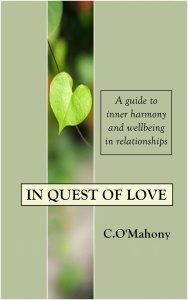
Extract from @In Quest of Love’ by Collette O’Mahony.
Life is a continual experience. The spirit feels. The mind creates. Interference in the mind leads to confused state of Being. Everything is energy. The spirit is gaseous energy. The mind is liquid energy. The body is solid energy. The problem for us humans is the attachment to solid energy, disregarding the preceding states of energy. Humans are preoccupied with ice, foregoing the water of mind and the vapour of spirit. Emotions gauge temperature. Fiery emotion quickly melts the ice of solid appearance. Cool emotion such as detachment solidifies the mental waters returning it to ice. Our lives require balance between the two states, to flow freely through the mind as pure water from the fountainhead.
We inhabit a world where spirit moves into appearance and unity into a myriad of variation. It is the mind that facilitates this experience of phenomena. Every man is a radial of the sun, as it points outwards to the circumference of earth, so too does it point back to its origin at the centre of all life. Both light and shadow point to the sun. The mind points firmly to the origin. The mind is powered by the centrifugal force of intellect. The spirit is power, it is the force that creates. The essence of every living thing is power and intellect. Nature is power directed from the origin of life force. It is operated by universal intelligence.
Human beings have freewill. Our spirit & mind are part of the origin, yet we have the choice to think and act separately. It is only when we become victim of our freewill do we seek to be rescued from our damning thoughts. However, many of us wish to be rescued from the result of vice but not always from vice itself. This is the dilemma for mankind. Fear and desire are the effect of infractions on the spirit. Confusion and folly are caused by infraction on the mind. Confusion of mind and fear in spirit is indicative of the human belief in a separate self. It is through mental anxiety and spiritual pain that eventually turns us away from the linear fringes of past & future, and allows the outer mind of humans to follow the centripetal path back to its origin. The heart is the receptacle for the radiation of spirit. When the central life force receives a signal from the spirit then the mind becomes porous to truth. Extreme individualism gives way to unity in unique expression. The vagaries of separate self are transformed by clear mind into magnanimous action.
The outer seeking of separate self leads the spirit into a catacomb of illusion and death. This subterranean existence rests on the belief that there is no other reality other than appearance. The spirit sleeps because it is unrecognised as an equal part of man’s essential nature, and mind takes centre stage as the apparatus by which form is held solid. The true power of spirit is reduced exponentially to the self-aggrandisement of ego. The resulting imbalance leads to the breaking of universal laws.
However, the fruit eventually ripens on the tree of cause & effect. If the cause is human vice, the effect is human suffering. As shareholders of this vice we are liable to its expiation.




 Feelings are energy in motion in the body. Emotional pain is energy seeking release. The default setting for the unconscious mind uses emotional pain to fuel repetitive thought patterns of victim hood and blame. If you quieten the mind for a few moments, through stillness; you can sense turbulent energy in the body. Scan your body from head to toe, see where feeling or sensation arises in your body. As you simply observe energy, without attaching a label to it, the sensation dissolves on its own. Mental activity only serves to define the feeling as hurt, anger, guilt or shame. It is thoughts about the feeling that cause emotional suffering. When you resist a feeling and accompanying thoughts, mental agitation increases. Awareness connects you with the true source of energy. Through awareness, thoughts are observed without attachment. The source of love is within you, accessed through awareness. You can connect to awareness through breathing. Simply focus on the breath as it rises and falls in your chest. At first, thoughts may demand your attention but through perseverance the mind starts to quieten. Thoughts can be like a runaway train, depleting your energy. It takes clear intention and focus to enter a place of awareness. In the calm oasis of stillness, you encounter your true being. Awareness proceeds from true being; it cannot be achieved through a mind made self or ego.
![93495e3898676fcf8a94bd76cf1ee71e[1]](https://colletteomahony.com/wp-content/uploads/2017/07/93495e3898676fcf8a94bd76cf1ee71e1.jpg?w=200)
 Collette OMahony (Author's blog)