Tag Archives: change

Overcoming Blind Spots in Our Behavior

We all have blind spots for our behaviour; sometimes it takes someone else to challenge us on our difficult or challenging behaviours. When confronted with these blind spots, we often become defensive or deny them, confusing our behaviour with our sense of identity. We may be within our rights to confront someone about their behaviour, but how we respond makes a difference in whether the situation is diffused or escalates.

If we can respond calmly, we might even get an apology. But if we react with anger, the other person is likely to deny their behaviour. To resolve our anger, we need to identify its source and address it directly with the person involved so they understand the effect their behaviour is having on us. If we stay silent, our bottled-up frustration will probably come out as misplaced anger later.

Accountability is paramount when facing the more challenging parts of our behaviour, feelings and beliefs. While we tend to evaluate others based on their behaviour, we primarily perceive ourselves through the lens of our good intentions rather than the quality of our behaviour. This form of myopia can obscure our awareness, causing us to act out in ways that misrepresent us, and offend others. This is our shadow self or blind-side, the obscured place where opinions, beliefs and prejudices go unnoticed and unchallenged. Developing awareness of our prejudices and assumptions, when processing new information, takes mindfulness and determination. If our behaviour is causing someone distress, it’s important to identify what that behaviour is and adjust our responses accordingly. We need to take responsibility for such maladaptive behaviours by interrupting the automatic cycle that connects emotional triggers to our behaviour and actions. We achieve this through mindfulness. Regular mindfulness practice and a commitment to discovering our true potential can transform our thinking, as well as our words and actions.

When our feelings are clear and unclouded, it leads to more focused thinking. Inspired thoughts that arise from our inner directive lead to inspired action. By taking ownership of our thoughts and actions, we convey a powerful message that we are progressing toward responsibility and unlocking our true potential.

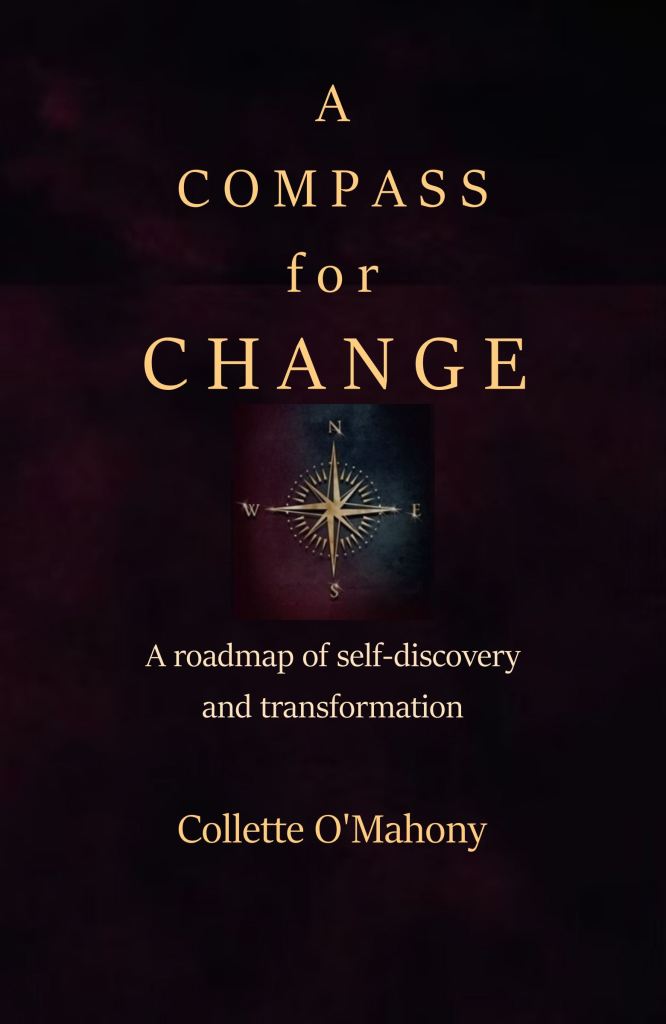
Extract from A Compass for Change – available now on Amazon.

Coping with unwelcome Change.

A cataclysmic event like the death of a loved one, divorce, or job loss dramatically shifts us from a state of stability into the unknown. Stability offers a sense of continuity, routine, and security, while such unexpected events dismantle that foundation, forcing us into a space where growth, adaptation, and emotional processing become necessary.

When something significant occurs, especially unexpectedly, it directly affects our mental health. These events disrupt our familiar patterns and throw our lives into emotional and practical turmoil. We may experience intense feelings of loss and grief, as our subconscious mind, which thrives on repetition and stability, struggles to cope with sudden change.

Whether the change is gradual, like separation and divorce, or immediate, like the sudden death of a loved one, the event triggers a cascade of emotional and psychological responses such as shock, grief, confusion, and even disorientation. In these moments, our natural inclination is to resist change. The subconscious mind clings to established routines and familiar behaviours, attempting to restore a sense of stability. For instance, someone experiencing bereavement may wake up expecting their loved one to still be there, only to be painfully reminded that they are gone. This is because the subconscious takes longer to process and accept changes that contradict its habitual patterns.

Faced with sudden, unwelcome change, resistance is a natural, almost automatic, reaction. This resistance stems from the mind’s need to hold on to the safety and familiarity of stability. Our subconscious mind is programmed to maintain order through daily habits and conditioned responses, but when those routines are shattered, the mind becomes overwhelmed, leading to a sense of confusion, forgetfulness, and emotional exhaustion. This is evident in the grieving process.

Grief

After the loss of a loved one, it can take weeks or even months for the subconscious mind to adjust to the new reality. During that time, the conscious mind bears the weight of constantly reminding the subconscious that the loss is real, which can feel mentally and emotionally exhausting. This ongoing mental battle adds to the feelings of disorientation that many grieving individual’s experience, leaving them questioning their sanity.

The subconscious starts to adapt in time, and the gradual process of adjustment to sudden change begins. Just as our mind gradually learned routines and habits during stable periods, it can relearn new patterns in the wake of change. But this adaptation doesn’t happen overnight. Eventually, as the subconscious begins to acknowledge the reality of the situation, the emotional and cognitive strain on the conscious mind starts to ease. As the subconscious adjusts, feelings of confusion and mental overload begin to lift. The grieving person starts to experience moments of clarity, and with it, the ability to process their feelings of loss in a more focused and manageable way. This adjustment marks the point where growth begins to emerge from the loss of stability.

A extract from my new book on change and inner transformation – A Compass for Change.

Change and Direction.

One thing to remember when navigating change that it is not a search for something. The seeds of change are already within us, our journey is a measure of distance between germination and fruition. We are born innocent but the seeds of wisdom are within us. Perhaps, we may lose our innocence on the path to wisdom, but the route from one to the other is the journey of a lifetime.  We are precariously perched on wings of hope and destiny, desperately trying not to fall into oblivion. But stronger wings grow from self-love and inner-strength, wings that lift us above fear and failure. These are the wings of Gratitude and Trust.

Our world cannot change by intentions alone. The behaviour and actions we take on our journey of change is reflected in each step along the way. Some parts may be pleasurable, others we take a much needed rest. There may be roadblocks and obstacles along our path, emotions like thunderstorms will rain down upon us to clear the way. Life will deliver the perfect conditions to support and nurture our growth. Pay close attention to conversations, reactions and habits, they hold clues to our unconscious patterns. Be especially vigilant when triggers are pushed, and the cause of it. It is easier to see faults and failings in others than in ourselves; there is an adage in terms of healing that ‘if you spot it you got it.’ We can turn this reflection to our advantage by making a note of what we resist. Our emotions charge our thoughts, our thoughts inform our behaviour, and behaviour creates character. We need to look at our character from an objective place, as an amalgamation of thoughts, emotions and behaviours. All these elements are interchangeable and fluid, it is our refusal to shift perspective that makes the character feel compacted and frozen in time. Real change is never outside of us, it is within. This requires our emotions to flow freely, our behaviour to be malleable and our thoughts to rise like vapour above the limitations of majority thinking.

The infinite in us is aware of the finite span of human life. Change and impermanence walk side by side on the road of mortality. Yesterday is consigned to memory and today is the genesis for tomorrow’s attainment. The illusion that things stay the same is down to the same images playing over and over in our mind. Change is certain and impermanence a given. Life by its very nature plants a seed, roots, germinates, grows, blossoms and bears fruit. The fruit contains the seed of new life and the cycle of life continues again.

Collette O’Mahony 09/03/2024

Extract from my upcoming book – A Compass or Change – available May/June.

Navigating Change

An extract from my upcoming guidebook – A Compass for Change.

When something cataclysmic occurs it has a direct effect on our mental health. This may be a gradual cause like separation and divorce, or an unexpected cause such as sudden death. The cause is the event, the effect is the feelings of loss and grief. We cannot undo the event no matter how much we may wish to but we can gradually process our feelings by giving them our attention. The effect of a job loss may shake our confidence and lead to financial uncertainty, on the other hand it may lead to better opportunities and increased salary. Preparation is the key to success in most fields of endeavour, it is similar for good mental health. Most people face a crisis when unwanted change is forced upon them through tragic or unavoidable circumstance. Similarly, those who try to avoid change reach a point where their health suffers due to a clash between their conditioned mind and their inner directive. The conditioned mind functions on schemas, the parameters laid down by learned habits, beliefs and structure. It arises from childhood and is influenced by family structure, schooling, regional and national thinking. On the other hand, the inner directive is our intuition, that which says something is wrong even if others try to convince you otherwise. Too often we allow ourselves to be swayed by what people think of us, or the mood of the collective.

Our initial response to enforced change is often resistance. This is understandable given how the subconscious operates. It takes longer for our subconscious mind to accept change, it runs on a conditioned loop compromising of our daily habits and cognitive learning, culminating in repetitive behaviour patterns. When these behaviour patterns are thrown into tumult through an unexpected event, the subconscious mind tries to default to the habitual patterns causing the thinking mind to struggle with the new situation. This is something that those who are bereaved struggle with, particularly in the early stages of grief, the conscious mind has to constantly remind the subconscious that their loved one is no longer with them. It can take several months for the subconscious to acknowledge the death, when it eventually does it reduces mental pressure. This permits normal functioning of the mind to resume and allow time for the bereaved person to process grief. Many bereaved people report feeling lost, confused, forgetful or think they are losing their mind; it could just be that the thinking mind is overloaded with functions that are normally designated to the subconscious. The subconscious will eventually register the change and adapt accordingly, but during the adjustment period there are feeling of loss and grief that require inner attention.

Many people take the view that free will is an illusion, and that our behaviour is governed by forces over which we have no control. Consequently, how we act or react is viewed as predictable or unavoidable. Our behaviour can be predictable, but that doesn’t make it’s inevitable. We can choose how to behave, but this is restricted if we determine we have to behave according to our structural belief system. As individuals we are free to choose our behaviour, we have a choice to act responsibly or irresponsibly.

Collette O’Mahony. 10/02/2024

Excerpt from the guidebook – A Compass for Change.