Category Archives: Essays

The Politics of Attention

Beneath the surface tensions cracking like chasms across our world, there is an inner world, a centre point where we replenish our energy. Now more than ever, it is important to draw our focus inward. Our energy is our most precious resource. When we lose sight of this, our attention shifts to outer, more tangible sources such as gas, oil and money. Attention itself functions as an energy source for leaders, industries and technologies that depend on visibility and engagement. This is one reason we perceive them as powerful; our sustained attention amplifies their influence. In this way, our precious resource, energy, is consumed and scattered across continents in the pursuit of profit and supremacy.
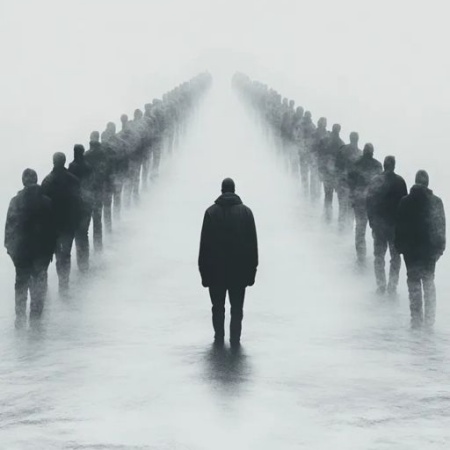
Internal conflict, when left unexamined, reflects outward as division in the world.

High-conflict traits are becoming more audible in the world. This noise drowns out the inner quiet we need in order to replenish our energy. A shift is required: away from pathologising outer conflicts, whether at home, at work or politically, and towards reclaiming our own agency and tending to our inner landscape.

If we find ourselves over-identifying with social and political rifts, it is worth examining what we gain from this attachment. There is a double-edged sword in engaging with people or groups caught in high-conflict patterns: validation on one side, criticism on the other. The outer dynamic may mirror an unconscious pattern in which we seek validation while capitulating to overly critical or controlling behaviour. We must decide where our responsibility for other people’s behaviour ends, and where our responsibility for safety and inner peace begins.

Inner and Outer Boundaries

Every country has its own boundaries, whether drawn on land or by sea, and people operate within its laws. When boundaries are invaded, conflict arises; the twentieth century stands as testament to this. We, too, have boundaries. We protect them by remaining centred and by drawing our focus inward. When we allow our attention to drift towards conflict and drama, we become vulnerable to invading forces. Once our energy strays beyond our boundaries, it is picked up and scattered like salt across the wound of the world.

Perhaps the work, then, is not to resolve the conflicts of the world, but to notice where our attention rests and to choose, again and again, where we place our energy. In moments of tension or outrage, we might pause and return to the quiet centre within, where boundaries are felt rather than defended. From this place, harmony becomes less about agreement and more about presence; less about changing others, and more about remaining intact ourselves.

Collette O’Mahony

21st January 2026

For enquiries about one-to-one counselling (zoom) click below: colletteomahony.com/counselling Psychotherapy

or,

send an email with you name and counselling goals to:

info@colletteomahony.com info@colletteomahony.com

The Language of Dreams

Last night a dream leapt up from my subconscious and forced me to remember that I have dreamed the same dream multiple times. The subconscious is a dangerous place full of hiding places for our fragmented souls and it launches an attack when our conscious mind is sleeping. The insomniac knows this trick and remains on guard throughout the long night. The subconscious is canny, it shows us a flash of a dream, enough for us to recognise it is a frequent visitor but then snatches it away in case our conscious mind goes to work on decoding its language. The language of the subconscious is in dreams and only the life force permeating our finite meanderings can understand its true meaning.  

Dreams like water have many fathoms, some skim the surface of our daily lives and others dredge deeply linking us to the unfathomable depths of infinity. There are dreams that are prescient in quality, forewarning us of the path we are about to take and others that excavate our emotional graveyard for buried trauma. Decoding dreams is a tricky business and the truth within them can only be felt, it cannot be told. In a way, dreams transcend death and mortality giving us a glimpse into a world beyond the waking mind and the repetitive noise that creates the rigid corners of our existence. Occasionally, we have a dream that presses a reset button and rids us, albeit temporarily, of our structured thoughts and beliefs. In these enlightened dreams, we can reach back in time to touch the great minds of the past, those unhindered by religion and societal constraints. It offers us a fresh objectivity on life as a whole, steering us past our cornered subjectivity.

We can enter into contemplation, a relaxed open state of mind allowing ideas to germinate and grow, rather than an active thinking mind where constant mental activity leads to a hurried pace within and without. When we are engaged in constant mental activity we enter a treadwheel of finite possibility, when we are in contemplation we are on the precipice of wonder. Contemplation is not mental laziness, it is a state of vibrational activity and offers fertile soil for new ideas. The means by which these new ideas bounce into life is by enthusiastic and creative response.

And so, back to my dream, a tool to circumvent my active thinking mind that is moving along life’s middle lane and missing out on contemplative opportunities. In the dream I am driving a car, an illusion of control, until in a flash I am moved into the passenger seat and trying to steer from the side-lines. I need to indicate and pull off the motorway, it’s time to allow the life force at the core of my being to take the steering wheel from the middle-of-the-road conscious mind. My acquiescence finally allows the dream to decode in my conscious awareness. I am not in control. I am in control. The dichotomy of my existence rests on this axis. The former occurs when I am trying to control my life through active thinking, the latter comes about through contemplative openness. Dreams are powerful communicators from the source of intelligence if only we would allow that source to work through us.

Photograhic credit: Rekha Garton.

Authenticity

Our level of thinking is directly related to our authentic self. The more we think, the less authentic we are and the less thinking, the more authentic we become. It’s a conundrum. How do we lessen our thoughts without overthinking it? Some people are masters at switching off and allowing their flow of thoughts to gently drip at a slower pace. Others find that the more they try to turn off the thinking tap, the more gushing and muddied the waters become. Meditation is generally cited as the best approach to quietening the mind. However, it is not a quiet hat to pull over your thinking cap to silence all your thoughts. It takes continuity of practice.

The road to authenticity begins at the point when we can no longer live with our conditioned self, the self bound by tradition, beliefs and expectation. We may come to this point through a personal crisis, or perhaps we might come in contact with an authentic person who ignites the flame of the authentic self within us. In my case, it was a combination of both. If we do not undertake this journey, we will continue to struggle and blame others for our shortcomings and frustrations. Worse still, we will project our dissatisfied self onto the people around us. Life is a mirror, it will reflect and attract the many facets of our character. Everyone is living a life created by their thoughts and these thoughts are generally caused by early conditioning, limited beliefs and expected achievements.

We must allow the emergence of our authentic self, we must encourage it, water it with conscious exercises such as breathing. Read the words of spiritual masters. Practice mindfulness, not only through meditation but in mundane tasks also. Become present to whatever it is you are doing in this moment. Otherwise, we will become misanthropes, at odds with ourselves and our fellow man because we cannot bear to see our limitations reflected to us through their thoughts, words and actions. Every political leader, celebrity or friend will become a mirror which we will want to crack from top to bottom because of the feeling it evokes in us.

Authenticity is a kind of inner rebellion. The true self struggles to outgrow the tight bud of ego, and to bloom in all its glory. After all, it is a seed of the cosmos. No less a star than those spilling forth from any cosmic nebula, straining to make their mark in the galaxy. We are star seeds, planted by the governing principle of the cosmos. To bloom, we must allow our conditioned self to wither, and watch as our authentic self flowers and brightens up our corner of the universe.

Collette O’Mahony

18/02/2021

Evolving as a Species.

The embrace of loved ones, moments shared in a busy café, or the joy of driving to a favourite beauty spot for a bracing walk are all simple pleasures put on hold for almost a year now. Loneliness, illness and death have shadowed our communities and our nations, and the coping mechanisms people employ to deal with stress, anxiety and grief have been stripped away during successive lockdowns. Social distancing, a term in itself that seems to contradict the purpose of society, has caused a secondary impact that will reverberate for years to come, perhaps changing forever our habits and rituals as a society.

We were cautioned about the catastrophe that awaited us if we didn’t adapt our ways and reduce our carbon footprint on the environment. Scientists and environmentalists issued a chorus of warnings about the perilous state of our planet. Our planet was in danger and we, humanity, were the cause. It seems to me that we were always the ones in danger, the planet existed millions of years before us, it knows how to rid itself of threats to its continuance. Maybe it is an arrogance in humans that we felt we must save the planet. We must save ourselves from the reaction of the planet if we continue to abuse its energy supply. The planet has its own intelligence and will deal with us in its own way. Unfortunately, there is no vaccine for ignorance. We cannot ignore the fact that we do not own the earth’s resources, we are guests here. If a guest entered our home and started pilfering our belongings, or littering our living room carpet with plastic and rubbish, there’s no doubt we would show them the door. The intelligence that guides us also guides the planet. It too, shows unwelcome guests the door.

Evolution has been happening on the planet for billions of years. The fittest survive, and thrive. Humans have thrived and multiplied to the detriment of other species. There is an imbalance. We must evolve as a species. This doesn’t mean we need to grow an extra thumb or expand our lung capacity. On a physical level, we do need to develop immunity against new viruses, however, the real shift must be an evolution in consciousness. We must develop an innate intelligence that connects us to the governing principle of the planet and the cosmos. If we continue to rely on the opinion of scientists and politicians to guide our path, we can readily ignore their opinions and advice. If we have a direct connection to the governing principle of the cosmos, we shall act accordingly, in harmony with every other living thing on the planet.

We must adapt and learn to interact with each other and the planet in a more conscious, harmonious way. Perhaps then we can return without guilt, or fear to our favourite beauty spots, cafés and bars.

Collette O’Mahony

09/02/2021

What is ‘Home’ ?

I am a seeker with a gypsy soul; adventure is the sum of my parts. Yet, it is always a kind of amiable pastime to dwell on the possibility of finding a place to call home. As the years roll by and the past recedes into a collage of faded photographs and occasional flashes of memory, I wonder what home means to me. Is it a country, a house, a family or merely a thought construct to tame my wandering soul?

For many people home means a family unit living under one roof. We grow up in our parents’ house with siblings and call it ‘home’. When we move out and make a new family unit, we call that home. I know several adults who always refer to the place they grew up as their home. I stopped that when my mother passed away, seventeen years after my father. Home left me and memories faded, no longer compounded by family get-togethers which invariably led down rural byways to childhood, enhanced by the passage of time into faded sepia photographs. Sometimes I dream in colour and I see the vividness of summer days spent on the farm of my childhood, tossing the hay, picking fruit, playing hide-and-seek with my sisters in the hay barn. Ironically, when someone presents me with a colour photograph from my youth, I recall the memory in black-and-white, a kind of foggy moment captured on camera. But my best memories are moments that no lens could capture, my reaction to the microcosm of nature, of life; tiny shells glistening like treasures in the sand, a butterfly emerging from its pupa, a bumble bee intent on tickling the extended fronds of a flower, tadpoles wiggling in a pool of water, endless moments in close proximity to unfolding life. Life birthing every new moment from the one before, like a telescopic event where years, seasons, days and moments in time recreated a new one especially for me. To me, this was home.

Decades on from my first close encounter with a ladybird tickling its way across my chubby fingers, I have witnessed many habitats and ecosystems on my travels and crossed paths with more poisonous creatures than my three-year-old self would ever care to witness. However, it is only when I return to the land of my youth, when I register specific smells and delight in the microcosm of local habitats, that I realise that I too, am a specific flower of this ecosystem. And this is what home means to me.

Collette O’Mahony

19/06/2020