Category Archives: self-help

Navigating Change

An extract from my upcoming guidebook – A Compass for Change.

When something cataclysmic occurs it has a direct effect on our mental health. This may be a gradual cause like separation and divorce, or an unexpected cause such as sudden death. The cause is the event, the effect is the feelings of loss and grief. We cannot undo the event no matter how much we may wish to but we can gradually process our feelings by giving them our attention. The effect of a job loss may shake our confidence and lead to financial uncertainty, on the other hand it may lead to better opportunities and increased salary. Preparation is the key to success in most fields of endeavour, it is similar for good mental health. Most people face a crisis when unwanted change is forced upon them through tragic or unavoidable circumstance. Similarly, those who try to avoid change reach a point where their health suffers due to a clash between their conditioned mind and their inner directive. The conditioned mind functions on schemas, the parameters laid down by learned habits, beliefs and structure. It arises from childhood and is influenced by family structure, schooling, regional and national thinking. On the other hand, the inner directive is our intuition, that which says something is wrong even if others try to convince you otherwise. Too often we allow ourselves to be swayed by what people think of us, or the mood of the collective.

Our initial response to enforced change is often resistance. This is understandable given how the subconscious operates. It takes longer for our subconscious mind to accept change, it runs on a conditioned loop compromising of our daily habits and cognitive learning, culminating in repetitive behaviour patterns. When these behaviour patterns are thrown into tumult through an unexpected event, the subconscious mind tries to default to the habitual patterns causing the thinking mind to struggle with the new situation. This is something that those who are bereaved struggle with, particularly in the early stages of grief, the conscious mind has to constantly remind the subconscious that their loved one is no longer with them. It can take several months for the subconscious to acknowledge the death, when it eventually does it reduces mental pressure. This permits normal functioning of the mind to resume and allow time for the bereaved person to process grief. Many bereaved people report feeling lost, confused, forgetful or think they are losing their mind; it could just be that the thinking mind is overloaded with functions that are normally designated to the subconscious. The subconscious will eventually register the change and adapt accordingly, but during the adjustment period there are feeling of loss and grief that require inner attention.

Many people take the view that free will is an illusion, and that our behaviour is governed by forces over which we have no control. Consequently, how we act or react is viewed as predictable or unavoidable. Our behaviour can be predictable, but that doesn’t make it’s inevitable. We can choose how to behave, but this is restricted if we determine we have to behave according to our structural belief system. As individuals we are free to choose our behaviour, we have a choice to act responsibly or irresponsibly.

Collette O’Mahony. 10/02/2024

Excerpt from the guidebook – A Compass for Change.

The Language of Dreams

Last night a dream leapt up from my subconscious and forced me to remember that I have dreamed the same dream multiple times. The subconscious is a dangerous place full of hiding places for our fragmented souls and it launches an attack when our conscious mind is sleeping. The insomniac knows this trick and remains on guard throughout the long night. The subconscious is canny, it shows us a flash of a dream, enough for us to recognise it is a frequent visitor but then snatches it away in case our conscious mind goes to work on decoding its language. The language of the subconscious is in dreams and only the life force permeating our finite meanderings can understand its true meaning.  

Dreams like water have many fathoms, some skim the surface of our daily lives and others dredge deeply linking us to the unfathomable depths of infinity. There are dreams that are prescient in quality, forewarning us of the path we are about to take and others that excavate our emotional graveyard for buried trauma. Decoding dreams is a tricky business and the truth within them can only be felt, it cannot be told. In a way, dreams transcend death and mortality giving us a glimpse into a world beyond the waking mind and the repetitive noise that creates the rigid corners of our existence. Occasionally, we have a dream that presses a reset button and rids us, albeit temporarily, of our structured thoughts and beliefs. In these enlightened dreams, we can reach back in time to touch the great minds of the past, those unhindered by religion and societal constraints. It offers us a fresh objectivity on life as a whole, steering us past our cornered subjectivity.

We can enter into contemplation, a relaxed open state of mind allowing ideas to germinate and grow, rather than an active thinking mind where constant mental activity leads to a hurried pace within and without. When we are engaged in constant mental activity we enter a treadwheel of finite possibility, when we are in contemplation we are on the precipice of wonder. Contemplation is not mental laziness, it is a state of vibrational activity and offers fertile soil for new ideas. The means by which these new ideas bounce into life is by enthusiastic and creative response.

And so, back to my dream, a tool to circumvent my active thinking mind that is moving along life’s middle lane and missing out on contemplative opportunities. In the dream I am driving a car, an illusion of control, until in a flash I am moved into the passenger seat and trying to steer from the side-lines. I need to indicate and pull off the motorway, it’s time to allow the life force at the core of my being to take the steering wheel from the middle-of-the-road conscious mind. My acquiescence finally allows the dream to decode in my conscious awareness. I am not in control. I am in control. The dichotomy of my existence rests on this axis. The former occurs when I am trying to control my life through active thinking, the latter comes about through contemplative openness. Dreams are powerful communicators from the source of intelligence if only we would allow that source to work through us.

Photograhic credit: Rekha Garton.

Time: Friend or Foe?

Time swoops into focus, nudging us with a ticking noise, ‘keep moving’ it says, ‘my survival depends on motion’. The mind, wired like a ticking clock, swings between right and wrong, swayed by excitement and an avalanche of opinions. One day, it’s taking sides in a political debate, the next it’s swallowing every story of the digital age. Pierce through the stories about fractious nations, warring families and rising inflation, climb down from the pendulous left to right motion that is stealing your valuable life.

Solitude is the enemy of time sitting still among the swirling edifice and finding the eye of the storm where sanity prevails. Seek nature, walk in the forest, climb a hill for the views, in ten years, even twenty, these are the shining moments of joy that decorate our lives. Daily news stories that readership devours will be assigned to the scrapheap of our minds. Every step we take in nature reduces this mind-fill and allows us to live life on our terms rather than become fodder for the beast.  In fifty or even a hundred year’s time no one will remember the irrelevance of commentary on insignificant stories, only facts will remain. Put down the phone, turn off the TV, step outside and take a deep breath. This is truth. We need air. We don’t need a constant drip feed from media outlets. Breath connects us with something greater than the news channels and apps that decorate our phone screen, it provides us with life. No one, ever, reached to check the latest news story when they were choking or in cardiac arrest. Breath is all important.

Every country has their headlines, every social network drowns in opinion swaying from left to right, we want free speech but only on our terms shouting down those who disagree. The online platform allows us to hide behind its shield and let our fingers do the talking. If we enter the slipstream of time and motion caused by outer phenomena we are in a state of reaction, positive action comes when we act from a place of stillness within.

Time moves at a speed corresponding to our mental activity. Slow the mind and time expands, fill the mind with news threads and we find ourselves swinging mercilessly upon the pendulum of time. If we wonder where the year has disappeared to, then we have consigned much of it to the scrapheap of our minds. If we can look back on the year and pick out several cherished moments, we have brought some balance to our lives. If, however, we sit in this moment neither looking backward or forward, we have achieved the magic moment that always exists, taking us beyond the boundaries of time into the very existence that pervades all life on earth and the universe.

Collette O’Mahony

January 2023

Avoidance Strategies

When love arises, it clears anything unlike itself. All fears, worries, false beliefs rise from the subconscious. Feelings of turmoil surface when fearful emotions and self-sabotaging thoughts start to arise in your awareness. Emotional pain can be acute causing you to use behavioural strategies to avoid difficult thoughts and emotions.

Set your intention to become aware of the avoidance strategies you employ to suppress feelings. It may be unhealthy habits such as overeating or food obsession, overspending on clothes, accessories or household items. Dependence on harmful substances such as drugs and alcohol are often used to mask emotional pain. Control issues such as obsessive-compulsive disorder or escapism into fantasy are attempts to numb the feeling body. Whatever your avoidance strategy, it affects your behaviour and those around you. Perhaps you are not aware you are using avoidance strategies. In many cases addiction is used to avoid your inner truth. Addiction is not the root of the problem, it is a symptom. The stronger the addiction is, the greater the pain beneath it. Guilt and shame compound addictions. Identifying with your habit or addiction strengthens its hold over you to the point where you are not even aware of it. Ask a trusted friend to help you identify your avoidance habits. Deeper issues such as substance abuse require the guidance of a professional. Once you see your avoidance strategy, set your intention to break the habit. Know that it is a learned behaviour pattern, it is not who you truly are. It is a temporary mask to cover the real you.

As fears come into your awareness, it takes vast amounts of energy to avoid them. Through ego, you use all kinds of distraction to avoid seeing truth. You want to avoid painful feelings arising from your past. Each time you identify with shame or guilt, you lock up the feelings energising them. Memories charged by fear, anger, or guilt have been shut in the emotional closet for too long. With positive intention and commitment to creating a new reality, avoidance habits rise into your awareness. When a feeling reaches the universal field of awareness, it can no longer operate in you through unconscious habits. You receive an inner nudge when you are reaching for another slice of cake or pouring one more glass of wine. At this point you can no longer blame your habit; you have an opportunity to make a choice to align with your intention for healing. You can ignore your behaviour or use the prompt to sit with arising feelings. Choose the present moment to overcome fear, expand your vision and create a new reality.

When you commit to being present, feelings associated with the past can be felt and released. Each time you acknowledge your avoidance mode, its grip weakens. Whether you feel attachment or guilt to the behaviour pattern, remain present to the feeling. Distracting yourself from the feeling only serves to strengthen it. To dissolve difficult feelings of guilt, shame, jealousy or anger, allow it to be present in this moment. Through your presence, these feelings can be absorbed by the universal field of awareness and transformed into free-flowing energy.

Collette O’Mahony

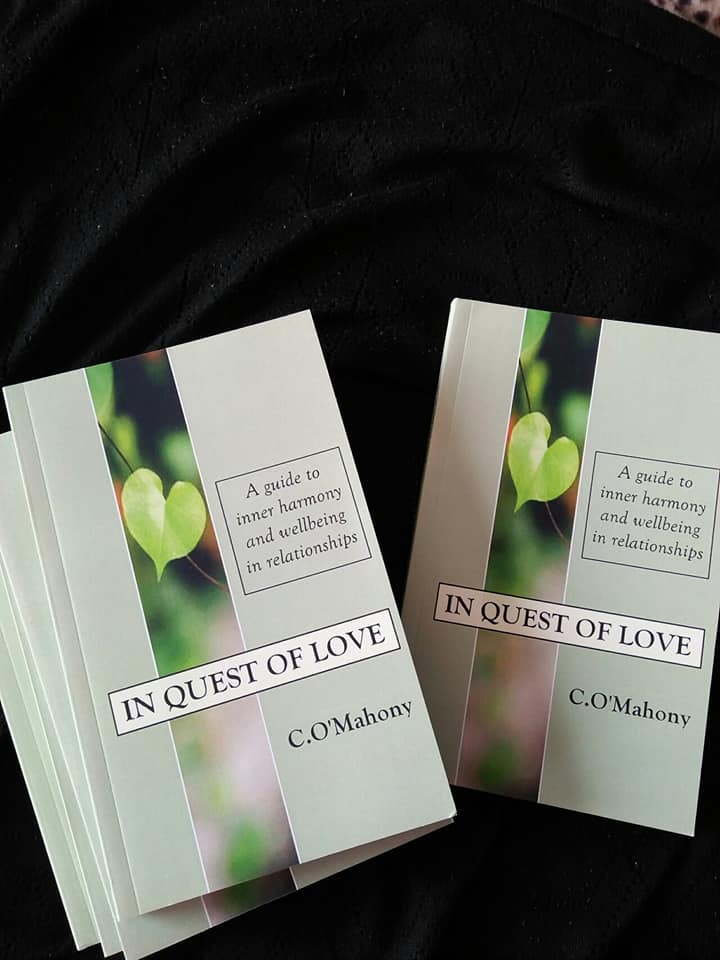
An extract from my book In Quest of Love

Click on image for availability.

In Quest of Love by Collette O’Mahony

Authenticity

Our level of thinking is directly related to our authentic self. The more we think, the less authentic we are and the less thinking, the more authentic we become. It’s a conundrum. How do we lessen our thoughts without overthinking it? Some people are masters at switching off and allowing their flow of thoughts to gently drip at a slower pace. Others find that the more they try to turn off the thinking tap, the more gushing and muddied the waters become. Meditation is generally cited as the best approach to quietening the mind. However, it is not a quiet hat to pull over your thinking cap to silence all your thoughts. It takes continuity of practice.

The road to authenticity begins at the point when we can no longer live with our conditioned self, the self bound by tradition, beliefs and expectation. We may come to this point through a personal crisis, or perhaps we might come in contact with an authentic person who ignites the flame of the authentic self within us. In my case, it was a combination of both. If we do not undertake this journey, we will continue to struggle and blame others for our shortcomings and frustrations. Worse still, we will project our dissatisfied self onto the people around us. Life is a mirror, it will reflect and attract the many facets of our character. Everyone is living a life created by their thoughts and these thoughts are generally caused by early conditioning, limited beliefs and expected achievements.

We must allow the emergence of our authentic self, we must encourage it, water it with conscious exercises such as breathing. Read the words of spiritual masters. Practice mindfulness, not only through meditation but in mundane tasks also. Become present to whatever it is you are doing in this moment. Otherwise, we will become misanthropes, at odds with ourselves and our fellow man because we cannot bear to see our limitations reflected to us through their thoughts, words and actions. Every political leader, celebrity or friend will become a mirror which we will want to crack from top to bottom because of the feeling it evokes in us.

Authenticity is a kind of inner rebellion. The true self struggles to outgrow the tight bud of ego, and to bloom in all its glory. After all, it is a seed of the cosmos. No less a star than those spilling forth from any cosmic nebula, straining to make their mark in the galaxy. We are star seeds, planted by the governing principle of the cosmos. To bloom, we must allow our conditioned self to wither, and watch as our authentic self flowers and brightens up our corner of the universe.

Collette O’Mahony

18/02/2021