Category Archives: Political

The Politics of Attention

Beneath the surface tensions cracking like chasms across our world, there is an inner world, a centre point where we replenish our energy. Now more than ever, it is important to draw our focus inward. Our energy is our most precious resource. When we lose sight of this, our attention shifts to outer, more tangible sources such as gas, oil and money. Attention itself functions as an energy source for leaders, industries and technologies that depend on visibility and engagement. This is one reason we perceive them as powerful; our sustained attention amplifies their influence. In this way, our precious resource, energy, is consumed and scattered across continents in the pursuit of profit and supremacy.
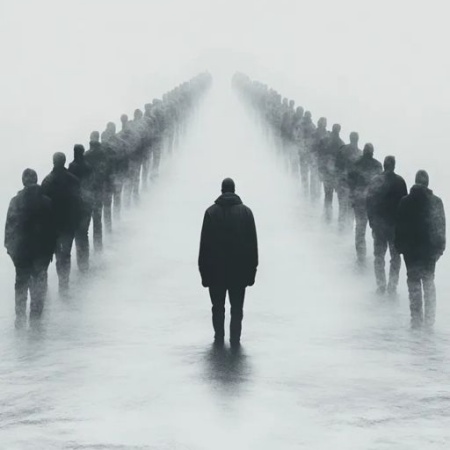
Internal conflict, when left unexamined, reflects outward as division in the world.

High-conflict traits are becoming more audible in the world. This noise drowns out the inner quiet we need in order to replenish our energy. A shift is required: away from pathologising outer conflicts, whether at home, at work or politically, and towards reclaiming our own agency and tending to our inner landscape.

If we find ourselves over-identifying with social and political rifts, it is worth examining what we gain from this attachment. There is a double-edged sword in engaging with people or groups caught in high-conflict patterns: validation on one side, criticism on the other. The outer dynamic may mirror an unconscious pattern in which we seek validation while capitulating to overly critical or controlling behaviour. We must decide where our responsibility for other people’s behaviour ends, and where our responsibility for safety and inner peace begins.

Inner and Outer Boundaries

Every country has its own boundaries, whether drawn on land or by sea, and people operate within its laws. When boundaries are invaded, conflict arises; the twentieth century stands as testament to this. We, too, have boundaries. We protect them by remaining centred and by drawing our focus inward. When we allow our attention to drift towards conflict and drama, we become vulnerable to invading forces. Once our energy strays beyond our boundaries, it is picked up and scattered like salt across the wound of the world.

Perhaps the work, then, is not to resolve the conflicts of the world, but to notice where our attention rests and to choose, again and again, where we place our energy. In moments of tension or outrage, we might pause and return to the quiet centre within, where boundaries are felt rather than defended. From this place, harmony becomes less about agreement and more about presence; less about changing others, and more about remaining intact ourselves.

Collette O’Mahony

21st January 2026

For enquiries about one-to-one counselling (zoom) click below: colletteomahony.com/counselling Psychotherapy

or,

send an email with you name and counselling goals to:

info@colletteomahony.com info@colletteomahony.com
World Leaders and Us

As coronavirus rips through our nations taking too many lives, the shock wave of illness and death is grinding slowly to a halt as fear about the financial implications takes over as the foremost consequence of this killer pandemic, demonstrating that after the threat of death, financial ruin comes close behind.

Every country moves at a different rate out of full lock down, each one looking to the next to see what is working and what is not, balancing re-opening the economy while minimising the risk of a second spike in covid-19 cases. I don’t envy world leaders their difficult task. While coronavirus exposes underlying health issues and mercilessly robs people of their loved ones, so too does it expose world leaders who did not make their nation’s health a priority. Some countries, such as Taiwan, New Zealand, South Korea and Germany moved quickly to prioritise the nation’s health and while they had fatalities, it was a fraction of the countries who favoured the economy over the elderly, finance over front line workers.

Here in the UK over 35,000 people have died since mid-March. A shocking loss to the country. These are not statistics but lives, hopes, dreams; voters who went to the polls last December and voted for their political leaders. The issue of the day was getting Brexit done. Few focused on health care and the repercussions of an underfunded NHS (National Healthcare System). The election running field was pretty much one sided with the Tories galloping home. Fast forward three months to early March and the onset of the pandemic; the Prime Minister fell at the first hurdle, and the rest of the field scrambled to avoid disaster. Sadly, they did not succeed. Britain is not the only country whose political hierarchy were exposed by the pandemic. Capitalist leaders who begrudgingly enforced a lock down, too late in many cases, demonstrated that administrations value money over lives.

I wonder what we can learn from our leaders, not just in our own country but from the leaders around the world. Do they reflect aspects in all of us, part empathy, part materialistic? How often do we weigh up the monetary cost above the social or civic cost? The mental health implications arising from not just the lock down, but from the national and international loss of life, will be great. We humans have more in common than we have differences. One thing that unites us is our emotions, our ability to feel happiness and joy, grief and sadness. The months of coronavirus have cast a long shadow over humanity, which may take years to lift.

Our leaders are really just a reflection of us, our light and our shadow, only they are the ones in the spotlight, the ones we abdicate responsibility to. Maybe it’s time to put ourselves under the spotlight, to asses our empathy, to see if we favour finance over health, and comfort over caution. We are all in this together, and it is up to us to keep taking steps towards a better future. We can’t continue to put responsibility for important issues in the hands of government and blame them when they get it wrong. While it is up to us to hold those in power accountable, we can’t fall into a comatose state in front of the TV and then rail against our world leaders for the state of the world. We must educate ourselves on environmental and health issues, and the long term implication these have on us as humans and the rest of the planet. If humanity is to survive, we the people, are its only hope.

Collette O’Mahony 22/05/2020

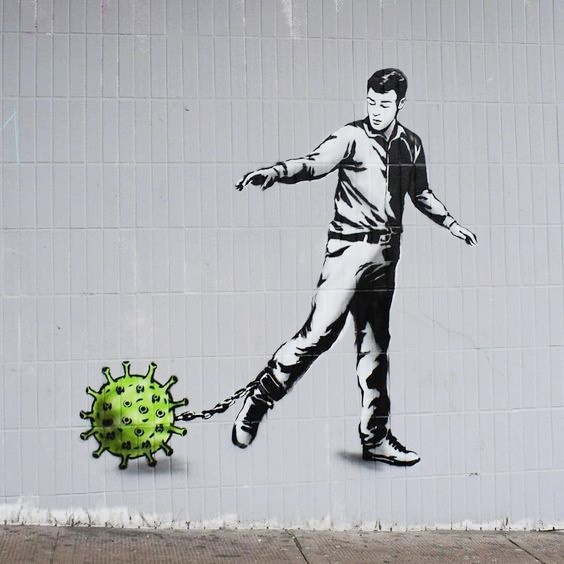
Art by @the.rebel.bear. Graffiti Street Art on Bath Street, Glasgow.